
English| USD
Suggested for you
More currencies
Choose a language
Bears are the animal most visitors hope to see between Moose and Colter Bay, yet no turnstile counts them. This how many bears are in grand teton national park guide sets out what biologists actually estimate and how those estimates are produced. Expect ranges rather than round certainties.
Quick answer
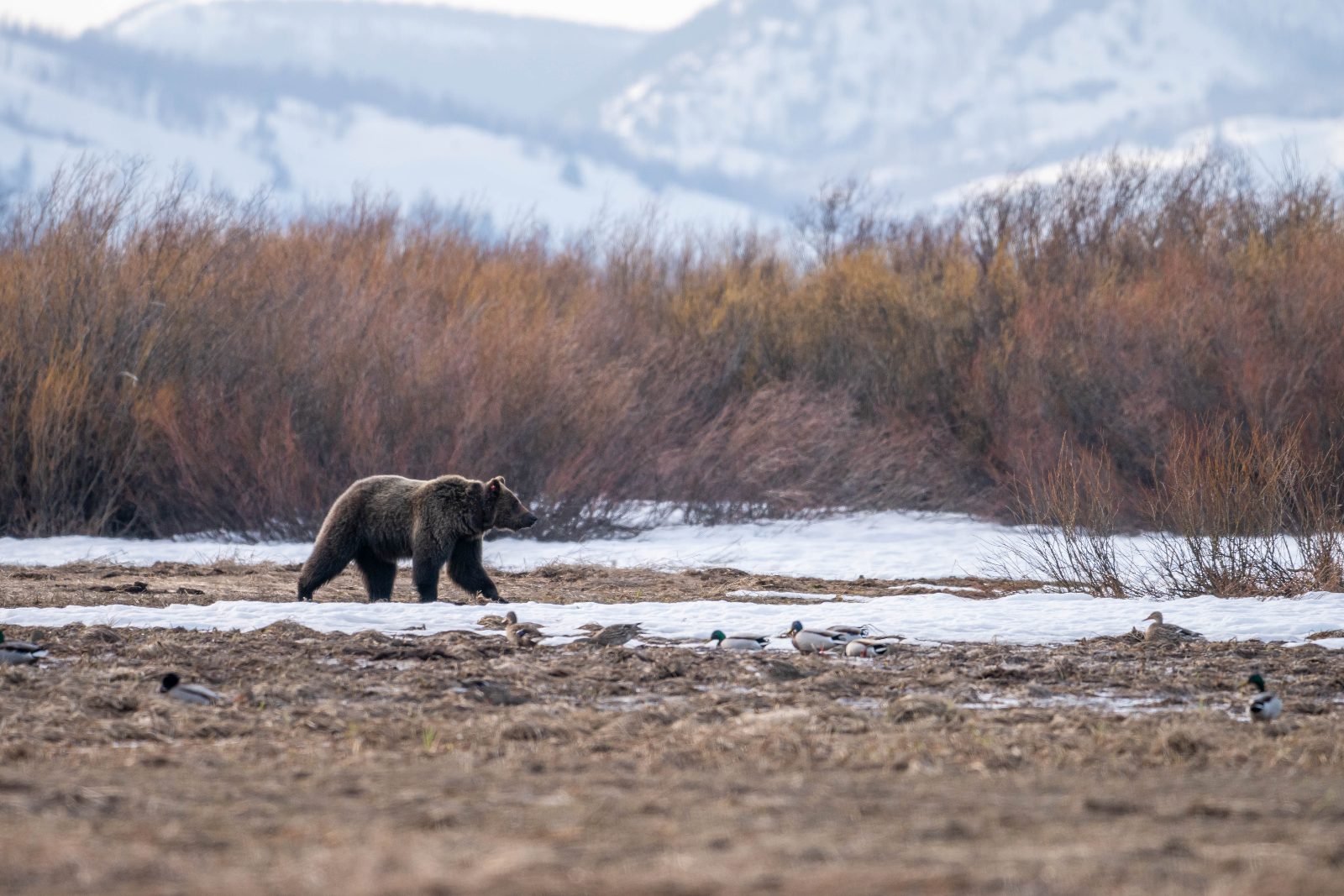
Grand Teton National Park has no single official bear census, but managers work from roughly 40 to 60 grizzly bears using the park and its immediate surroundings, plus several hundred black bears. The grizzly figure sits inside a Greater Yellowstone Ecosystem population of around 1,000 animals. Counts shift each year with cub survival, food supply, and movement across park boundaries.
The most closely watched grizzly in the Rocky Mountains lived here. Bear 399, born in 1996, produced eighteen cubs before she was struck and killed by a vehicle south of Jackson in October 2024. Her celebrity skewed expectations. Visitors arrive picturing named individuals with roadside habits, when the honest version of how many bears are in Grand Teton National Park describes a population that shifts across a landscape much larger than the park boundary. Nobody stands at a gate tallying ursids. Grizzly numbers in the Greater Yellowstone Ecosystem are tracked by the Interagency Grizzly Bear Study Team, which combines radio-collar telemetry, DNA hair-snare sampling, aerial observation flights and counts of unique females with cubs of the year. Black bears receive far less monitoring; their estimate rests largely on habitat modelling and incident reports. The result is a range, revised annually, rather than a fixed headcount — and the Grand Teton bear population is a subset of a wider regional figure, not a closed one. Geography explains the fuzziness. Bears travel freely between the park, Bridger-Teton National Forest, the John D. Rockefeller Jr. Memorial Parkway and Yellowstone to the north. A grizzly feeding on whitebark pine seeds high on the Teton crest in September may be foraging in the willow flats near Oxbow Bend a week later. Pilgrim Creek, the Moose-Wilson Road corridor and the Snake River bottomlands concentrate animals seasonally, which is why sighting frequency rises and falls without the underlying number changing much. For a visitor, the practical takeaway is that the answer is probabilistic. Sightings are never guaranteed by arriving early, though the park's recommended arrival window of 06:00–09:00 improves the odds. Naturalist-led Grand Teton wildlife tours add spotting scopes, radio-linked guides and route knowledge that a single vehicle rarely matches. Reading how many bears are in Grand Teton National Park as a range, then planning around it, produces a better trip than treating any figure as a promise.
“The park does not count bears so much as keep track of them.”
Grand Teton National Park serves as a critical habitat for both grizzly and black bear populations within the Greater Yellowstone Ecosystem. Wildlife biologists monitor these populations to track movement and health across the park's diverse terrain.
The Greater Yellowstone Ecosystem supports a grizzly population estimated at over 600 individuals, many of which frequent Grand Teton National Park. These bears have expanded their range significantly over the last several decades.
While exact numbers fluctuate, black bears are considered common throughout the forested areas of the park. They are often more elusive than grizzlies but maintain a stable presence across diverse elevations.
Bear distribution changes throughout the year based on food availability, such as spawning cutthroat trout or ripening berries. This movement means the number of bears within park boundaries is not static.
The Interagency Grizzly Bear Study Team conducts annual research to estimate population sizes and trends. This collaboration ensures data-driven management across state and federal jurisdictions.
Grand Teton is one of the few places in the lower 48 states where grizzly and black bears coexist in high numbers. Visitors should be prepared for the possibility of encountering either species during their travels.
Professional guides utilize current park data to locate wildlife in appropriate habitats while maintaining safe distances. Learning about these population dynamics provides context for the behaviors observed during field tours.
Grand Teton is home to both black bears and grizzlies, and the National Park Service requires visitors to stay at least 100 yards from any bear. How you behave on trails, at pullouts, and around your food determines whether an encounter stays uneventful.
To maximize opportunities for observing bear activity, visitors should plan their arrival during the best arrival window of 06:00–09:00. This period aligns with the crepuscular nature of bears while avoiding peak daytime traffic.
30°F to 60°F. Bears emerge from dens and forage in valley bottoms.
50°F to 80°F. Bears move to higher elevations to escape midday heat.
30°F to 65°F. Bears enter hyperphagia, feeding intensely on berries and roots.
—. Early hours provide the quietest conditions for wildlife observation.
Verdict: The optimal opportunity for sightings occurs from 06:00–09:00 during the months of May, June, or September.
Access to Grand Teton National Park requires a standard vehicle entrance fee. These fees support park operations and visitor services.
Verdict: A typical visitor pays 35 USD for a standard 7-day vehicle pass, with additional fees applicable for non-US resident adults.
Everything you need to know about how many bears are in grand teton national park
The best way to view wildlife is to use binoculars, a spotting scope, or a telephoto lens from your vehicle or a safe, designated distance. Staying in your car is the safest method if you encounter a bear near the road, as it provides a secure barrier. Avoid creating or joining 'bear jams' that block traffic, as these situations can be dangerous for both people and animals. Respecting the wildlife's need for space is the most responsible way to enjoy the park.
Open Air Vehicle Safaris
Read more Tickets & toursWildlife Safari & River Floats
Read more Tickets & toursSunset Wildlife Tours
Read more GuidePark Planning Guide
Read more Tickets & toursWinter Wildlife Tours
Read more Tickets & toursWildlife Safaris
Read more Tickets & toursWildlife Photography Tours
Read more Tickets & toursPrivate Wildlife Tours
Read more